I used Generative AI (predominantly Claude) in a limited manner while writing this blog. I found it most useful at the start of the course, as a source for references while trying to get a sense of the ‘shape’ of the field, and understanding the links between different pedagogical ideas — for example, understanding how the literature on constructionism (an area I’d been interested in learning more about) related to that on object-based learning.
As the course has gone on and my understanding has deepened, I’ve found it more rewarding to search for references without the help of these tools. I have also used it occasionally to check formatting on references.
John came to watch me teach an introductory tutorial for the electronics bench. It was very helpful and interesting to hear his feedback reflect areas of concern for us, about the development and maintenance of strong social relationships within the workshops. While this wasn’t the focus of this reflection, John’s presence for this workshop also prompted me to think further about how to structure these sessions to avoid overloading students.
After writing introductions for my teaching observations, I realised I am often concerned about how to manage cognitive load during teaching (Didau, 2016). Most of my work involves supporting students with little or no prior experience to learn complex technical tasks outside of the structure of weekly classes. As such, tactics for reducing overwhelm and helping students feel comfortable making use of the workshops are very important.
An intrinsically complex task (van Merriënboer, 2006) I teach is the Introductory Electronics Bench tutorial, which covers basic electronics theory (including circuit diagrams), correct and safe usage of the soldering equipment, hand tools, and power supply. These tutorials often over-run, and I am concerned they can be informationally dense and occasionally overwhelming. I would like to redesign them to reduce the cognitive load, while still ensuring students leave feeling able to assemble their own circuits.
A tinkercad pictoral representation of a circuit (left) vs a circuit diagram, or schematic representation of the same circuit (right). The picture can help someone initially assemble the circuit, but doesn’t promote long term understanding.
Reflection
I found Paas and van Merriënboer’s (1994) discussion of instructional control helpful in making sense of techniques I already use to make intrinsically difficult tasks more accessible to students, and in considering approaches I could take to further decrease cognitive load. Their emphasis on the use of worked examples was helpful: a way we could realise this would be to include example circuits on the CCI wiki for students to construct as practice.
Also helpful in characterising teaching strategies was Vygotsky’s (1978) discussion of tools and symbols as components of learning, and the formation of intelligent relationships to the world. At present, the workshop covers both the development of a symbolic language (in the form of schematic representation) and tool use (the soldering iron). While these are complementary and both need developement, these can take a long time to internalise as independently usable skills (Vygotsky, 1978).
It might be possible to separate the teaching of these aspects — and indeed, sometimes we do, in the case of an annual synthesiser-building workshop where soldering is taught, and a theoretical session is offered afterward. However, it is important not to emphasise practice at the expense of theory, as the latter can help students construct a schema to help reduce cognitive load in a longer term (Paas and van Merriënboer, 1994). Instead of starting with soldering, another approach could be to require students to have already attended a session on circuit diagrams that focusses on breadboard prototyping, another important skill.
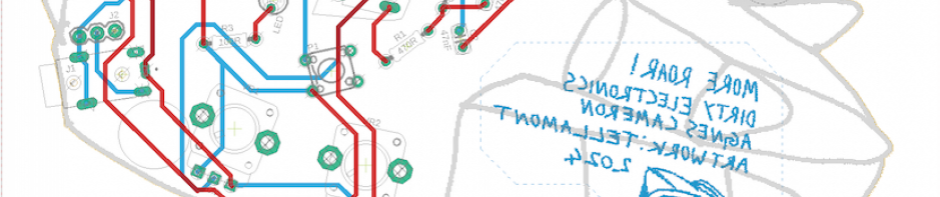
one of the More Roar synth-building workshops run by John Richards and myself last year at the CCI. To make the workshop manageable for students, we almost completely separated the theoretical and practical parts.
I also appreciated Vygotsky’s articulation of the Zone of Proximal Development, the ‘level’ at which a student can work when supported by additional guidance (Vygotsky, 1978). For many of my students, the time-bound nature of their courses means that many of their more ambitious projects do require technical support to realise, and it is helpful to see this form of ‘scaffolded’ learning (which much of my role consists of) as an important stage in a learning process.
References
Didau, D., Rose, N., (2016), ‘What Every Teacher Needs to Know about Psychology’, pp. 43-49 John Catt Educational Ltd, ISBN 9781909717855
Paas, F.G. and van Merriënboer, J.J.G., (1994), Instructional control of cognitive load in the training of complex cognitive tasks. Educational psychology review, 6(4), pp.351-371.
van Merriënboer, J.J., Kester, L. and Paas, F., (2006), Teaching complex rather than simple tasks: Balancing intrinsic and germane load to enhance transfer of learning. Applied Cognitive Psychology: The Official Journal of the Society for Applied Research in Memory and Cognition, 20(3), pp.343-352.
Vygotsky, L.S. (1978) Mind in Society: The Development of Higher Psychological Processes. Cambridge, MA: Harvard University Press.
For my observation of a peer’s teaching, I visited Nicola’s Sonic Visions workshop at CSM. I was really impressed by Nicola’s teaching, and greatly enjoyed being a part of her class. I particularly appreciated the way she maintained a norm of calm and focus in the space.
Nicola came to visit my class on satellite imaging, taught to the Diploma students. I really appreciated her reflections on the class — it helped me to think further about the way I structure and use information in my teaching, and led to further reflections around cognitive load, which I discuss in my final reflective post.
The most appropriate foundation we can imagine right now is one that fosters both the inclination and ability to participate in this process—to articulate current social and cultural phenomena as a group in order to work parallel to them individually. (Bailey, 2010)
I’ve been reading Stuart Bailey’s three pamphlets initiated as part of Parsons’ School of Design’s Academic Workshop, an internal effort in the mid-2000s to reshape the design curriculum. One of Bailey’s core proposals is that the ‘Bauhaus-style’ model still emulated by many art schools at the time, in which students progressed from a basic technical foundation, was outdated and should be reconsidered (Bailey, 2007). In discussing this proposal, Bailey underlines the idea that the proposed approach “isn’t AGAINST teaching basic techniques… only FOR an explicit consenus regarding the whole those components are intended for” (Bailey, 2009).
the original Bauhaus skills wheel and the English translation (right)
In (Only an Attitude of Orientation), Bailey advocates for a ‘pragmatic method’ focussed on outcomes and consequences over preconceptions and principles (Bailey, 2009). This is an approach paralleled by The Carpentries, who take an approach to teaching computational skills driven by practical necessities over computer science theory, arguing that a pragmatic approach will allow people to feel empowered in their work with computers (Wilson, 2019). Bailey also insists that “the ongoing process of attempting to understand ‘is absolutely productive'” (Bailey, 2009).
Reflection
I can relate these ideas to my own experiences organising the Technical Skills Workshops at the CCI, which opt for a ‘concrete’ approach to technical skills. I enjoyed Bailey’s invocation of radical 18th-century schooteacher Joseph Jacotot, who insists that Everything is in Everything — e.g. learning is revealed through students’ observations and relations to a medium (Bailey, 2009). I believe this is true in many ways of technical objects: part of the philosophy of the technical skills workshops is that engaging with any specific skill will aid student’s learning as a whole, even if they seem unrelated.
Technical Skills programme from Autumn 2025
In the third and final pamphlet, From The Toolbox of a Serving Library, Bailey (Bailey 2011) suggests replacing the Bauhaus-informed foundation of many design programmes by a structure based on the Photoshop toolbox “…not in order to capitulate to market demand, of course, but to interrogate its preferences”. This ‘Photoshop-proxy’ course is an interesting provocation, and makes me wonder what an equivalent in creative computing would be. One workshop we’ve debated running for a while is one on the use of AI tools, partly because of our experience of how deletirous the use of these can be to students’ learning. However, I wonder about designing a workshop that truly engages these tools and their limits — potentially in a form of creative misuse, in the vein of artists like Herdimas Anggara and Jaakko Pallasvuo. After all, Bailey’s definition of “criticism” as the ability to confront a subject as it happens (Bailey, 2009).
Lastly, taking Bailey’s invitation to articulate a shared intention between staff and students (Bailey 2009), I feel strongly that “moving from consumers to producers [of technology]” (Lee, 2015) is one of the core ideas behind the technical skills workshops. While it is far from the only orientation in the department, it’s a sentiment I’ve heard echoed by colleagues more generally, and would benefit from further collective discussion.
References
Bailey, S. 2007, Towards a Critical Faculty [Pamphlet], in Frances Stark and Stuart Bailey (eds.), On the Future of Art School: A Primer, Los Angeles: University of Southern California, available here
Bailey, S., 2009, (Only an attitude of orientation) [Pamphlet]. Oslo, Norway: Office for Contemporary Art, available here
Bailey, S., 2011, From the Toolbox of a Serving Library [Pamphlet], The Serving Library and the Banff Centre, available here
Lee, J. 2015, Moving from Consumers to Producers, in Nuncera D. ed., Teaching Community Technology Handbook, Detroit Digital Justice Coalition, available here
Wilson, G. (2019) Teaching Tech Together: How to create and deliver lessons that work and build a teaching community around them. Taylor & Francis. ISBN: 978-0-367-35328-5
“How do you learn the things you don’t know you don’t know?” (Taeyoung, 2020)
I shared the concern of other staff in the PGCert workshop around students not realising when they lack core technical skills, and I’m interested in the role of feedback in addressing this. As I work primarily as a technician, my role does not involve formal assessment. The feedback I provide has two main modes:
ad-hoc verbal feedback provided in the form of tutorials and ‘walk-in’ support
the development of learning materials that allow students to assess their own progress
I hadn’t considered the second mode as ‘feedback’ until reading (Nicol, 2006) on self-regulated learning, which emphasises the need for students to be provided examples of what ‘good performance’ is, and provide guidance for them to develop their own practice. On finishing a knit tutorial, for example, I let students know that they should be able to complete a square sample reliably before moving on to more advanced material, and display samples in the knit room for students to compare their work to.
knit samples seen on a recent visit to the Chelsea knit workshops: these give students a way to benchmark their own skills
Technicians at the CCI maintain an open wiki that documents our equipment and resources, and includes a range of learning guides. Last year, I also developed the physical computing project index as a way of communicating to students and staff what is possible with the equipment we have, thus articulating the ‘possibility space’ of projects within the CCI and the relative difficulty of different approaches.
The CCI physical computing project index
Reflection
I want to develop the CCI Wiki to provide more benchmarking and self-assessment resources, building on existing work on the physical computing index but orienting more specifically around feedback and development, to support students in developing self-regulated learning.
I’m inspired by the GSAPP Skill Trails, a technical resource for students studying architectural computation at Columbia University (Taeyoung, 2020). The metaphor of hiking a trail is used to emphasise the non-hierarchical nature of the material, where multiple ‘paths’ can be taken through different skills, while acknowledging their relative difficulty. It was developed specifically to accomodate the needs of a fast-growing course where students were struggling to keep up with technical material.
the GSAPP skill trails interface (Taeyoung, 2020)
I will make use of the existing wiki structure to provide resources in the form of structured checklists. For example, after completing an introductory soldering tutorial, students could be sent a list of skills to practice before booking a more advanced session, encouraging them to see electronics as an area that they can also learn through self-directed study (Nicol, 2006). In addition, a guide to what projects are possible at each tutorial level can help students to have a more realistic idea of what level they are working at, and to scope projects better. These changes will help scaffold learning outside of contact hours, and allow students to have a more well-rounded idea of their own level and development.
References
Nicol, D.J. and Macfarlane‐Dick, D., (2006), Formative assessment and self‐regulated learning: A model and seven principles of good feedback practice, Studies in higher education, 31(2), pp.199-218.
[students] realize that these artifacts are in fact the result of much thought, iteration, and analysis; i.e., the design process. These products do not just “happen”. (Shepperd, 1992)
For my microteaching exercise, I chose to run a laptop disassembly task based on the e-waste workshops we run in the CCI. For 20 minutes, participants were instructed to collaboratively take apart a scrap laptop as far as they could with provided tools, while discussing three questions that prompted them to identify components, discuss standardisation, and identify different manufacturing processes. This approach was inspired by Prown’s forensic analysis (Prown, 1980), and mechanical dissection tasks that encourage critical thinking through reflective material engagement (Sheppard, 1992). Following a risk assessment, I chose to remove the battery (due to fire risk), and advised participants to wash their hands after the activity.
dismantling the network card (Nicola and me, left) and the hard drive (Chris and Sunny, right)
beforeafter
Reflection
Overall, I thought this task was partly successful. It felt easy to involve everyone, and all participants relayed that they found the task enjoyable. I was able to avoid talking entirely for the first part of the exercise, in which students correctly identified the laptop model and some components, though I helped later on to identify more obscure components. Participants only engaged with the first question, but used it as the basis for a thoughtful discussion.
The more critical feedback I recieved described the task as ‘unstructured’. In response, another participant remarked that she would want to keep the freeform nature of the exercise, describing it as ‘learning through play’. This is also a tension in the e-waste workshop — students enjoy the open-endedness, but there’s a feeling of ‘now what’ once an object is disassembled, and guidance is required to make meaning from the scrap.
Three questions were too ambitious: the first question (around part identification) was sufficient for the allotted time, but risked over-emphasising prior knowledge in the students. This topic might have been better explored by focussing on specific components, reducing the intrinsic cognitive load of the task by drawing attention to parts within the whole (van Merriënboer et. al, 2006), and thus requiring less external guidance.
A potential replacement for questions would be a ‘treasure hunt’ of different electrical connectors combined with short descriptions of their use. Connectors provide many clues about the higher-level functionality of components, and the ‘goal-free’ task of identification from images could free up more capacity for students to engage with the higher-level learning outcome (Didau and Rose, 2016), while introducing a tactic also used by electronic engineers.
Lastly, one participant said that they would appreciate more discussion of practical repair technique — while this was out of scope for the time period, it’s an important consideration for our longer e-waste workshops in the department, as it intersects with both sustainability and safety concerns.
References
Didau, D., Rose, N., (2016) ‘What Every Teacher Needs to Know about Psychology’, pp. 43-49 John Catt Educational Ltd, ISBN 9781909717855
Prown, J.D. (1980) ‘Style as evidence’, Winterthur Portfolio, 15(3), pp. 208–215. Available at: https://doi.org/10.1086/495962
van Merriënboer, J.J.G., Kester, L. and Paas, F. (2006), Teaching complex rather than simple tasks: balancing intrinsic and germane load to enhance transfer of learning. Applied Cognitive Psychology, 20: 343-352. https://doi.org/10.1002/acp.1250
Sheppard, S. D., (1992), “Mechanical Dissection: An Experience in How Things Work,” Engineering Education: Curriculum Innovation & Integration, Santa Barbara, CA, Jan. 6–10, pp. 1–8 Available at: http://www-cdr.stanford.edu/images/Dissection/dissphil.pdf
I found the object-based learning lecture interesting for a few reasons. I’d slightly misunderstood what object-based learning was, and it was interesting to hear about different frameworks that got learners to do most of the talking in class. The one I was most drawn to Prown’s Forensic Analysis (Prown, 1980) — I enjoyed the materialist aspect of the analysis, and how rooted it is in the objects themselves, and I found it easier to relate to a technical context than the other examples.
One of the things I found surprising about it was the extent to which the frameworks and techniques didn’t immediately fit well with the teaching we do in the CCI, despite so much of our teaching having to do with objects. Prown specifically describes artistic objects as being distinct “from tools or mechanical devices” in being responsive to an analysis of form, and that “the configuration of a functional object… is almost completely determined by its purpose” (Prown, 1980).
Additionally, many technical objects operate at high levels of abstraction — packaged in standardised components that can make it very hard to discern functionality without higher level technical knowledge. Despite absolutely being cultural and social artefacts, analysing them in terms of outward appearance would miss a huge amount of potential information about what it actually is that they do in the world (that also forms a lot of their cultural/social function).
A 555 timer, a simple but effective timing circuit from the 1970sa STM32 microcontroller, an arm-core processor capable of very complex and fast operationDespite looking almost identical, these chips serve a very different function — the one on the right is millions of times more complex.
After thinking for a while, I could come up with a couple of examples from my own technical and teaching work that felt like they fit the broader technique (inquiry led mostly by questions/speculation from students rather than talking from staff). The first has a more material approach; the second takes a more science-and-technology studies focus, to understand a technical object in terms of its wider social implications.
E-waste workshop
The e-waste workshop is an annual workshop run by CCI technicians where we take apart electronic waste produced in the lab over the course of the year. This has included projectors, laptops, toasters, kettles, scanners and one huge iMac. The format of the workshop is that everyone — technicians, students — takes apart different items and asks each other questions about how they are made and how they work.
These questions bridge different technical areas — parts of physics, standards bureaucracy, manufacturing processes, supply chains, the politics of repair — that produce a way of looking at everyday technical objects. In some ways it’s almost an inverse of Prown’s approach — taking a contemporary object with which everyone is familiar, but finding questions that are less asked about it. Perhaps, reflecting on the original question, one of the ways to subject a technical object to this kind of learning technique is to take it apart.
Databases
For some teaching work I did at the CCI on open data, I came up with a list of questions to ask about databases, to help students think critically about them as social objects. These are partly inspired by Data Feminism (D’Ignazio and Klein, 2020), and partly from my own work on public access data provenance with the Knowledge Futures Group.
Who made it?
Who paid for it?
What knowledge does it claim to represent? Is this accurate?
Where does the information in it come from? Does the database tell you about this?
How often is it updated? Who maintains it?
Is there a record of the changes made? A version history?
Am I able to challenge what’s in it? What’s the process for that?
Is it accessible? Can I get a copy of it?
Is the information in it legible? To whom?
These questions help to frame and situate the database as a social rather than a technical artefact — made by people, and subject to stylistic cultural and political decisions. It’s still not an exact match for something like Prown — by definition, most of these questions can’t be answered just by looking at databases themselves (and in fact many of these questions have non-answers, which are also indicative).
Reflections
I’d like to think more about how to combine these approaches, and explore them in the microteaching exercise. I’ve written elsewhere about my interest in the militarised aspects of technical development, though I think these histories can be hard to read from the objects themselves without some introduction — and I’m also really interested in teaching techniques which involve me talking less! I think combining some transfer of specialist knowledge with tools to scaffold students to do that is what I’m most interested in.
References
D’Ignazio, C. and Klein, L.F. (2020) Data feminism. Cambridge, MA: MIT Press
Prown, J.D. (1980) ‘Style as evidence’, Winterthur Portfolio, 15(3), pp. 208–215. Available at: https://doi.org/10.1086/495962.
I’m interested in a trend observed by myself and colleagues at the CCI where some digital skills that are assumed prerequisites for our courses are now unfamiliar to a large fraction of incoming students. Examples of these include:
finding files in folders
extracting files from an archive
installing software
This trend has been observed more broadly across computing education. Despite increased accessibility of digital technology, digital literacy has decreased in school-age students over the past decade (IEA, 2025). In particular, the skills listed above rely on a mental model of the computer as a nested system of files, which for many users has been superceded by a search-and-apps model (Chin, 2021). This difference poses a challenge to students and lecturers, as the filesystem model is still a core aspect of how computers operate, and important for learning programming.
Preparation
Last year, I developed a series of interdisciplinary workshops for incoming students, aimed at developing these skills before they enter the CCI. These were modelled after Carpentries workshops in content and philosophy, framing the material around practical tasks that students might encounter in an arts context (Wilson, 2019), such as image editing and web design. I took inspiration from Melanie Hoff’s class Folder Poetry, which uses poetic metaphors to teach filesystem structure, and her insistence that users of computers are ‘always already programming’ (Hoff, 2018). The learning outcomes were refined via an informal poll of colleagues, of “essential computer skills that your courses presume that are often not possessed by students”.
Stickers for the workshops, designed by ex-CCI student Kesiah Ide
The workshops were piloted with existing students in Spring 2025. Feedback from the pilot (gathered through forms after each workshop) was positive, though a minority reported that they had found the pace too fast. Given attendees had two terms of experience, and as volunteers were likely to be more engaged, this indicated that the workshops needed to be simplified, to move “at the pace of the slowest learner” (Wilson 2019).
Reflection
After teaching the workshops last Autumn, I would further alter some aspects, as most attendees did not report completing the tasks. I believe this was either an issue of engagement, or the teaching environment: in each workshop there were four current students available for questions, but they were under-utilised by attendees.
Glitching a .jpg file to learn about file formats and binary code
One approach would be to further break tasks down into smaller interactive elements, rather than as components of longer creative tasks. Having the tasks be more independent of one another could reduce the chances of attendees getting lost. An area that I would also like develop was the post-workshop student feedback, which I didn’t formally gather, and would have been helpful to better understand how effective the workshops were.
As an additional next step, I am planning to establish a Technical Teaching Working Group in the department, providing a peer lens (Brookfield, 1995) on the development of foundational technical skills. This will provide an avenue for staff to discuss how to adapt teaching material to accommodate differences, and an opportunity for myself and other technicians to learn how to further support lecturing staff.
References
Brookfield, Stephen (1995). Becoming a Critically Reflective Teacher. San-Francisco: Jossey-Bass.
International Association for the Evaluation of Educational Achievement (IEA) (2025) An international perspective on digital literacy: results from ICILS 2023. Cham: Springer. Available at: https://doi.org/10.1007/978-3-031-87722-3.
Wilson, G. (2019) Teaching Tech Together: How to create and deliver lessons that work and build a teaching community around them. Taylor & Francis. ISBN: 978-0-367-35328-5, accessed here