After writing introductions for my teaching observations, I realised I am often concerned about how to manage cognitive load during teaching (Didau, 2016). Most of my work involves supporting students with little or no prior experience to learn complex technical tasks outside of the structure of weekly classes. As such, tactics for reducing overwhelm and helping students feel comfortable making use of the workshops are very important.
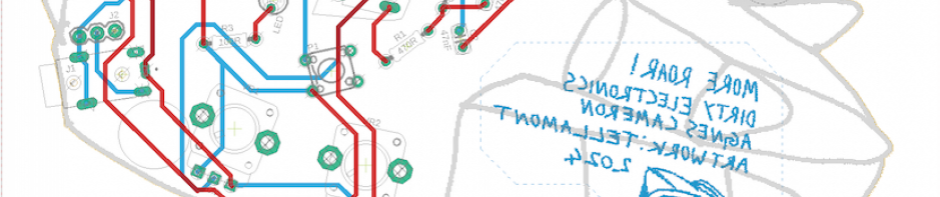
An intrinsically complex task (van Merriënboer, 2006) I teach is the Introductory Electronics Bench tutorial, which covers basic electronics theory (including circuit diagrams), correct and safe usage of the soldering equipment, hand tools, and power supply. These tutorials often over-run, and I am concerned they can be informationally dense and occasionally overwhelming. I would like to redesign them to reduce the cognitive load, while still ensuring students leave feeling able to assemble their own circuits.

Reflection
I found Paas and van Merriënboer’s (1994) discussion of instructional control helpful in making sense of techniques I already use to make intrinsically difficult tasks more accessible to students, and in considering approaches I could take to further decrease cognitive load. Their emphasis on the use of worked examples was helpful: a way we could realise this would be to include example circuits on the CCI wiki for students to construct as practice.
Also helpful in characterising teaching strategies was Vygotsky’s (1978) discussion of tools and symbols as components of learning, and the formation of intelligent relationships to the world. At present, the workshop covers both the development of a symbolic language (in the form of schematic representation) and tool use (the soldering iron). While these are complementary and both need developement, these can take a long time to internalise as independently usable skills (Vygotsky, 1978).
It might be possible to separate the teaching of these aspects — and indeed, sometimes we do, in the case of an annual synthesiser-building workshop where soldering is taught, and a theoretical session is offered afterward. However, it is important not to emphasise practice at the expense of theory, as the latter can help students construct a schema to help reduce cognitive load in a longer term (Paas and van Merriënboer, 1994). Instead of starting with soldering, another approach could be to require students to have already attended a session on circuit diagrams that focusses on breadboard prototyping, another important skill.
I also appreciated Vygotsky’s articulation of the Zone of Proximal Development, the ‘level’ at which a student can work when supported by additional guidance (Vygotsky, 1978). For many of my students, the time-bound nature of their courses means that many of their more ambitious projects do require technical support to realise, and it is helpful to see this form of ‘scaffolded’ learning (which much of my role consists of) as an important stage in a learning process.
References
Didau, D., Rose, N., (2016), ‘What Every Teacher Needs to Know about Psychology’, pp. 43-49 John Catt Educational Ltd, ISBN 9781909717855
Paas, F.G. and van Merriënboer, J.J.G., (1994), Instructional control of cognitive load in the training of complex cognitive tasks. Educational psychology review, 6(4), pp.351-371.
van Merriënboer, J.J., Kester, L. and Paas, F., (2006), Teaching complex rather than simple tasks: Balancing intrinsic and germane load to enhance transfer of learning. Applied Cognitive Psychology: The Official Journal of the Society for Applied Research in Memory and Cognition, 20(3), pp.343-352.
Vygotsky, L.S. (1978) Mind in Society: The Development of Higher Psychological Processes. Cambridge, MA: Harvard University Press.